DTOs (Data Transfer Objects)
In enterprise application architecture, mixing database persistence entities directly with data transferred across the network is a common source of vulnerabilities and performance degradation. The DTO (Data Transfer Object) pattern is a foundational solution to decouple internal domain models from public API contracts.
1. The DTO Pattern and the Isolation Boundary
A DTO is a plain object (POJO) whose sole responsibility is transporting data between software layers (e.g., between the service layer and the REST controller), containing zero business logic or persistence annotations:
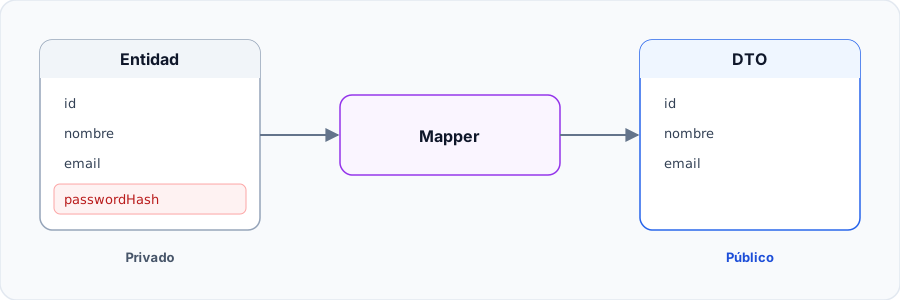
Component Breakdown and Architectural Rationale
| Diagram Layer | Representative Class | Why It Must Be Isolated |
|---|---|---|
| Private Zone (Persistence) | @Entity Usuario | Directly models SQL database tables. Contains sensitive fields (passwordHash, salt), internal metadata (createdAt), and bidirectional relationships (@OneToMany List<Pedido>). |
| Risks of Exposing Entities | Data Leakage & Bugs | 1. Secret leakage: JSON serialization can expose password hashes or audit fields. 2. Infinite recursion in Jackson: If User has orders and each Order references user, serialization collapses with a StackOverflowError.3. Mass Assignment attacks: A malicious client could send {"id": 1, "role": "ADMIN"} in a JSON body and overwrite protected properties if bound directly to the entity. |
| Transformation Layer | MapStruct | Filters, copies, and converts only authorized attributes between entities and DTOs. |
| Public Zone (REST API) | UsuarioDTO | Provides a clean, stable projection optimized for web and mobile clients. Changes in database table columns do not break the public API contract. |
2. DTO Types by Operation
Robust applications design differentiated DTOs for incoming versus outgoing data:
- Request DTOs (Input): Represent data sent by the client to create or update a resource (e.g.,
UsuarioCreateDTO). Include validation annotations (@NotBlank,@Email,@Size). - Response DTOs (Output): Represent projected data authorized for client consumption (e.g.,
UsuarioResponseDTO). Never contain passwords or internal hashes.
Hierarchies with Abstract DTOs
When multiple DTOs share common fields (such as name and email), we can define an abstract base class:
package com.ejemplo.demo.dto;

/**
 * Abstract class to reuse shared attributes.
 * Cannot be directly instantiated; serves as a template for concrete DTOs.
 */
public abstract class PersonaBaseDTO {
    private String nombre;
    private String email;

    public PersonaBaseDTO() {}

    public PersonaBaseDTO(String nombre, String email) {
        this.nombre = nombre;
        this.email = email;
    }

    public String getNombre() { return nombre; }
    public void setNombre(String nombre) { this.nombre = nombre; }

    public String getEmail() { return email; }
    public void setEmail(String email) { this.email = email; }
}
package com.ejemplo.demo.dto;

/**
 * Extends PersonaBaseDTO adding employee-specific fields.
 */
public class EmpleadoDTO extends PersonaBaseDTO {
    private String cargo;
    private Double salario;

    public EmpleadoDTO() {}

    public String getCargo() { return cargo; }
    public void setCargo(String cargo) { this.cargo = cargo; }

    public Double getSalario() { return salario; }
    public void setSalario(Double salario) { this.salario = salario; }
}
3. Automatic Mapping with MapStruct
Writing manual entity-to-DTO conversions (dto.setName(entity.getName())) is repetitive, error-prone, and cumbersome to maintain. MapStruct is an annotation-processor-based code generator for Java that automates this translation.
How MapStruct Works (Compile-Time vs. Runtime)
Unlike libraries like ModelMapper that rely on runtime reflection (which adds overhead to every HTTP request), MapStruct operates during compilation (javac):
Key advantages:
- Maximum Performance: The generated implementation consists of plain getters and setters. It executes as fast as handwritten code.
- Type Safety: If a field is renamed or types mismatch, the compiler raises an error before code reaches production.
- Zero Heavy Dependencies in Production: Does not require complex reflection engines.
4. Hands-on MapStruct Integration Guide
Configure Dependencies and Maven Plugin
Add MapStruct dependencies and configure the annotation processor in your pom.xml:
<properties>
    <org.mapstruct.version>1.5.5.Final</org.mapstruct.version>
</properties>

<dependencies>
    <!-- MapStruct annotation core -->
    <dependency>
        <groupId>org.mapstruct</groupId>
        <artifactId>mapstruct</artifactId>
        <version>${org.mapstruct.version}</version>
    </dependency>

    <!-- Support for Java 8 Date/Time types with Jackson -->
    <dependency>
        <groupId>com.fasterxml.jackson.datatype</groupId>
        <artifactId>jackson-datatype-jsr310</artifactId>
    </dependency>
</dependencies>

<build>
    <plugins>
        <!-- Compiler plugin configuring MapStruct annotation processor -->
        <plugin>
            <groupId>org.apache.maven.plugins</groupId>
            <artifactId>maven-compiler-plugin</artifactId>
            <version>3.11.0</version>
            <configuration>
                <annotationProcessorPaths>
                    <path>
                        <groupId>org.mapstruct</groupId>
                        <artifactId>mapstruct-processor</artifactId>
                        <version>${org.mapstruct.version}</version>
                    </path>
                </annotationProcessorPaths>
            </configuration>
        </plugin>
    </plugins>
</build>
Define the Mapper Interface
Declare an interface annotated with @Mapper(componentModel = "spring"). The componentModel = "spring" parameter instructs MapStruct to mark the generated implementation with @Component, allowing it to be injected directly into any Spring service:
package com.ejemplo.demo.mapper;

import com.ejemplo.demo.dto.UsuarioResponseDTO;
import com.ejemplo.demo.model.Usuario;
import org.mapstruct.Mapper;
import org.mapstruct.Mapping;

@Mapper(componentModel = "spring")
public interface UsuarioMapper {

    /**
     * Maps from Entity to Response DTO.
     * Properties with matching names (id, nombre, email) map automatically.
     */
    UsuarioResponseDTO toDTO(Usuario usuario);

    /**
     * Inverse mapping from DTO to Entity
     */
    Usuario toEntity(UsuarioResponseDTO dto);
}
Advanced Mapping and Field Renaming
When property names differ between the entity and DTO, or when delegating nested mappings, use the @Mapping annotation:
package com.ejemplo.demo.mapper;

import com.ejemplo.demo.dto.ProyectoResponseDTO;
import com.ejemplo.demo.model.Proyecto;
import org.mapstruct.Mapper;
import org.mapstruct.Mapping;

// 'uses = {TareaMapper.class}' delegates conversion of nested task collections
@Mapper(componentModel = "spring", uses = {TareaMapper.class})
public interface ProyectoMapper {

    /**
     * Explicit field mapping:
     * - 'titulo' on the entity maps to 'nombreProyecto' on the DTO.
     * - 'passwordSecreta' is deliberately ignored.
     */
    @Mapping(source = "titulo", target = "nombreProyecto")
    @Mapping(target = "passwordSecreta", ignore = true)
    ProyectoResponseDTO toDTO(Proyecto proyecto);
}
Inject and Use the Mapper in the Service Layer
Inject the generated mapper into the service to transform domain objects before handing them to the controller:
package com.ejemplo.demo.service;

import com.ejemplo.demo.dto.UsuarioResponseDTO;
import com.ejemplo.demo.mapper.UsuarioMapper;
import com.ejemplo.demo.model.Usuario;
import com.ejemplo.demo.repository.UsuarioRepository;
import org.springframework.beans.factory.annotation.Autowired;
import org.springframework.stereotype.Service;

@Service
public class UsuarioService {

    @Autowired
    private UsuarioRepository usuarioRepository;

    @Autowired
    private UsuarioMapper usuarioMapper; // Injected MapStruct-generated bean

    public UsuarioResponseDTO buscarPorId(Long id) {
        Usuario usuario = usuarioRepository.findById(id)
                .orElseThrow(() -> new RuntimeException("User not found"));

        // Clean, type-safe conversion to DTO
        return usuarioMapper.toDTO(usuario);
    }
}
5. Summary of Best Practices
- Never return JPA entities directly in a
@RestController: Protect your application from accidental data exposure and mass assignment attacks. - Use independent Request DTOs and Response DTOs: Each operation has distinct validation requirements and data exposure boundaries.
- Leverage MapStruct to eliminate boilerplate mapping code: Saves hundreds of lines of repetitive code while ensuring compile-time type verification.