JWT Foundations and Architecture
To build secure, high-performance REST APIs in Spring Boot, it is crucial to understand the JSON Web Token (JWT) standard, its cryptographic foundations, and how it integrates into the Spring Security lifecycle.
This guide explores the theoretical concepts, token anatomy, authentication and authorization request flows, and answers the most critical security questions encountered in real-world systems.
1. What is JWT and Why is it Used in REST APIs?
A JSON Web Token (JWT) is an open standard defined in RFC 7519 that establishes a compact and self-contained format for securely transmitting structured information between parties as a JSON object.
Key Characteristics
- Compact: Due to its dot-delimited string structure, a JWT can easily be transmitted via HTTP headers (
Authorization: Bearer <token>), URL query parameters, or POST request bodies. - Self-Contained: The token carries all necessary information about the authenticated subject (identifier, roles, issuance timestamp, expiration). The server does not need to look up session tables or RAM heaps to identify the client.
- Cryptographically Verifiable: Although anyone can decode and inspect its contents, the token contains a digital signature generated using a secret key known only to the issuing server. This guarantees that data has not been tampered with in transit.
2. Cryptographic Anatomy of a JSON Web Token
A JWT token consists of three independent parts, each encoded in Base64Url and joined together by dots (.):
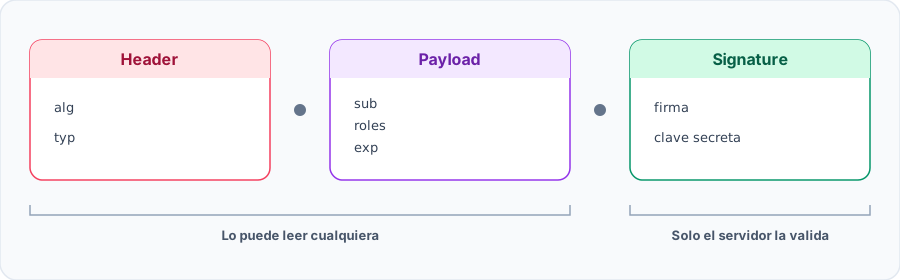
Component Breakdown
A. Header
Declares the token metadata: the cryptographic signing algorithm (alg) and the token type (typ):
{
  "alg": "HS256",
  "typ": "JWT"
}
alg: "HS256": Specifies HMAC with the SHA-256 hash function.typ: "JWT": Identifies the token as a JSON Web Token.
B. Payload (Claims)
Contains claims regarding the entity (typically the user) and additional operational metadata:
{
  "sub": "user123",
  "email": "juan@example.com",
  "roles": ["ROLE_USER"],
  "iat": 1773517905,
  "exp": 1773604305
}
- Registered Claims (RFC 7519): Predefined standard claims:
sub(Subject): Unique identifier of the user (e.g., username or database ID).iat(Issued At): Epoch timestamp when the token was created.exp(Expiration Time): Epoch timestamp after which the token is invalid.
- Custom Claims: Application-specific properties (e.g.,
email,roles, ortenantId) that allow services to make authorization decisions without querying a database.
The Header and Payload are merely Base64Url-encoded, not encrypted. Anyone who intercepts the token can decode and inspect the data in plain text. Never place passwords, secret keys, or confidential information inside a JWT payload.
C. Signature
Guarantees authenticity and integrity. It is computed by taking the Base64Url-encoded Header, the Base64Url-encoded Payload, and signing them with a server-held secret key (SECRET_KEY):
HMACSHA256(
  base64UrlEncode(header) + "." + base64UrlEncode(payload),
  SECRET_KEY
)
If an attacker modifies even a single character in the Payload (e.g., changing "ROLE_USER" to "ROLE_ADMIN"), the recalculated signature will not match the token signature, causing the server to immediately reject the request.
3. Flow 1: Token Issuance (Login Flow)
To obtain a JWT token, the client submits credentials to a public authentication endpoint:
Interacting Components in Issuance
| Component | Role in the Flow |
|---|---|
SecurityFilterChain | Allows unauthenticated access because /api/public/** is configured with permitAll(). |
AuthController | Exposes the REST endpoint and deserializes the JSON request body into a LoginRequestDTO. |
AuthService | Orchestrates authentication: queries the user, validates the password using PasswordEncoder, and requests a signed token. |
PasswordEncoder | Safely compares the plain text password submitted by the user against the BCrypt hash stored in the database. |
JwtService | Uses the JWT library (JJWT) to assemble claims, set expiration, and sign the token using the secret key. |
4. Flow 2: Consuming Protected Endpoints (JWT Authorization)
Once the client receives the token, it includes it in the Authorization header of all subsequent requests using the Bearer scheme:
GET /api/usuarios/10 HTTP/1.1
Host: localhost:8080
Authorization: Bearer eyJhbGciOiJIUzI1NiIsInR5cCI6IkpXVCJ9...
5. Architectural Decisions in Spring Security
Why does JwtAuthenticationFilter go BEFORE UsernamePasswordAuthenticationFilter?
In Spring Security configuration, we register the filter using:
.addFilterBefore(jwtAuthenticationFilter(), UsernamePasswordAuthenticationFilter.class)
Technical Rationale:
UsernamePasswordAuthenticationFilteris the default filter designed for form-based login (POST /loginwith form-urlencoded fields or sessions).- In a stateless REST API (
/api/**), we need our JWT filter to inspect theAuthorization: Bearer <token>header, validate the cryptographic signature, and populateSecurityContextHolderbefore any other filter attempts to redirect the user to a form or reject the request as unauthenticated. - When execution proceeds down the chain toward authorization filters (
AuthorizationFilter), Spring Security already finds the authenticatedAuthenticationobject ready in context.
Is an AuthenticationProvider Required or is a Simple Filter Sufficient?
In Spring Security architecture, there are two primary approaches:
- Direct Filter Approach (
OncePerRequestFilter):- The filter extracts the token,
JwtServicevalidates signature and claims, and the filter directly builds aUsernamePasswordAuthenticationTokenplaced intoSecurityContextHolder. - Advantage: Clean design, fewer classes, high processing speed, and loose coupling. Recommended for modern REST APIs and microservices.
- The filter extracts the token,
- Custom
AuthenticationProviderApproach:- The filter creates an unauthenticated token, delegates to
AuthenticationManager.authenticate(), which dispatches to a customAuthenticationProvider. - When needed: Only when an application coordinates multiple disparate authentication backends (e.g., LDAP + biometric + JWT in the same chain). For standard REST services, the direct filter is cleaner and easier to maintain.
- The filter creates an unauthenticated token, delegates to
6. Critical Security Scenarios
What Happens if a JWT Token is Stolen?
Because JWT is stateless, the server does not track issued tokens in memory. If an attacker intercepts the token (via Man-in-the-Middle or XSS), the server will accept it until it expires.
Mitigation Strategies in Production:
- Enforce HTTPS (TLS): Encrypts all network traffic, preventing interception of HTTP headers.
- Short Expiration Windows: Configure
accessTokenwith a short lifespan (e.g., 15–60 minutes) to minimize exposure. - Use Refresh Tokens: Keep the access token short-lived, while maintaining a database-backed, revokable refresh token.
- Secure Client Storage: In web browsers, store tokens in cookies flagged with
HttpOnly; Secure; SameSite=Strict, preventing JavaScript-based XSS extraction.
What Happens if an Attacker Modifies the Token?
If an attacker alters the payload (e.g., trying to claim "roles": ["ROLE_ADMIN"]):
- The attacker modifies the JSON and re-encodes it in Base64Url.
- When received by the server,
JwtService.isTokenValid(token)re-computes the signature using the server'sSECRET_KEY. - Because cryptographic signatures are mathematically bound to every bit of the header and payload, the computed signature will not match the token signature.
- JJWT throws a
SignatureException, and the request is immediately rejected with HTTP401 Unauthorized. It is mathematically impossible to alter claims without invalidating the signature unless the server secret key is compromised.
What Happens When User Permissions Change in the Database?
This is known as the Stale Claims issue.
- Default Behavior: If an administrator revokes a role at 10:00 AM, but the user holds a token issued at 9:55 AM with validity until 10:55 AM, the server continues accepting old permissions for the remaining 55 minutes, because token validation does not touch the database.
- Resolution Strategies:
- Option A (Short Expiration): Reduce token lifespan to 10–15 minutes, making the stale window negligible.
- Option B (Lightweight DB Lookup in Filter): Inside
JwtAuthenticationFilter, invokeuserDetailsService.loadUserByUsername(username)to load fresh authorities on each request. Provides immediate consistency at the cost of one database query per request. - Option C (Revocation Cache): Track the timestamp when user permissions changed in an in-memory cache. If the token's
iatclaim predates that timestamp, reject the token immediately.