Spring Ecosystem and Layered Architecture
In enterprise Java application development, one of the greatest advantages of using Spring Framework is that it handles the infrastructure or "plumbing" code (plumbing code). This allows development teams to focus their effort exclusively on business logic.
1. The Concept of "Plumbing Code" in Spring
In software engineering, the term plumbing refers to all repetitive support code that provides no direct business value but is essential for the application to run. Examples include:
- Manual creation and management of object instances.
- Manual connection and dependency injection between components.
- Resource, transaction, and session management.
- Abstractions to connect with databases or remote services.
By delegating object creation and assembly to Spring via XML configuration, Java application code remains clean (POJOs), free from rigid dependencies, and easy to unit test.
2. Overview of the Spring Ecosystem
The Spring ecosystem is not a single monolithic block, but an interconnected family of independent and modular projects built to solve specific challenges in the lifecycle of a Java application:
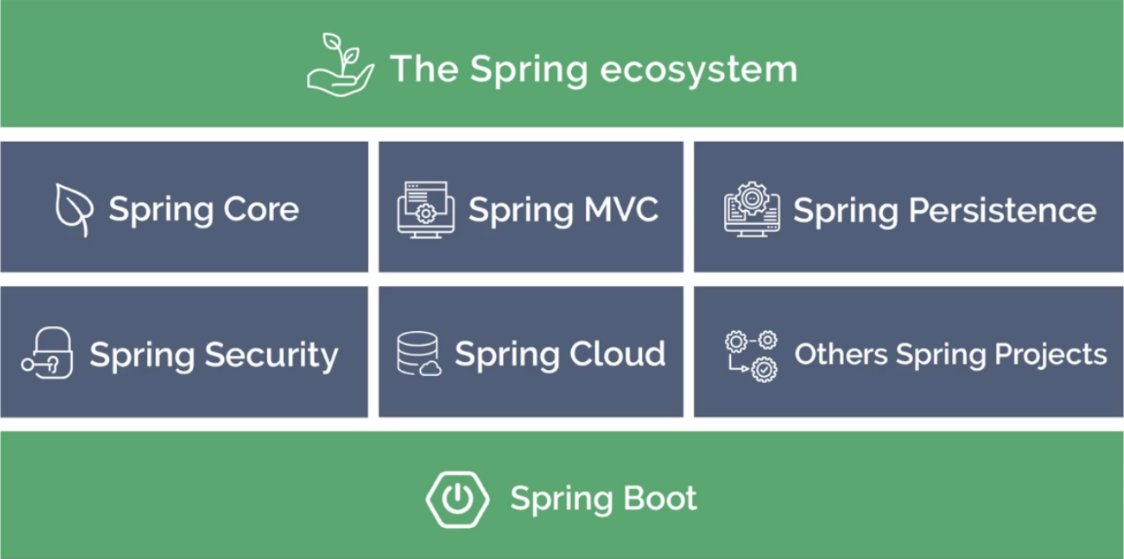
Key Ecosystem Components
Based on the architecture shown in the diagram above, the ecosystem is broken down into the following key pillars:
- Spring Boot (Foundation): The technological foundation sustaining modern Spring projects. It provides auto-configuration and embedded servers to quickly launch applications without requiring complex initial setups.
- Spring Core: Represents the fundamental core of the framework. It is responsible for Inversion of Control (IoC), the bean container, and dependency injection via XML or Java.
- Spring MVC: Presentation layer framework implementing the Model-View-Controller pattern to build standardized web applications and REST APIs.
- Spring Persistence: Set of tools and abstractions (like Spring Data / JDBC / ORM) designed to simplify interaction with relational and non-relational databases.
- Spring Security: Module dedicated to authentication, authorization, and protection against common web vulnerabilities (CSRF, XSS, session fixation).
- Spring Cloud: Infrastructure for building distributed systems and microservice architectures (service discovery, centralized configuration management, routing).
- Other Spring Projects: A wide range of specialized extensions such as Spring Batch (batch processing), Spring Integration (messaging), Spring GraphQL, among others.
3. Layered Architecture: Model - Repository - Service
To guarantee Separation of Concerns, a Spring application is hierarchically divided into specialized layers. Each layer has a single purpose and communicates exclusively with its adjacent layer via interfaces (abstractions).
Layer Responsibility Matrix
| Layer | Key Component | Main Responsibility | Communication Rule |
|---|---|---|---|
| Presentation | Servlet / Controller | Receives client HTTP requests, extracts parameters, and delegates execution. | Only invokes the Service Layer via its interface. |
| Service (Business) | Service | Contains business rules, validations, and operation orchestration. | Invokes the Repository Layer via abstract interfaces. |
| Repository (Data) | Repository / DAO | Manages data access (CRUD operations in memory, files, or database). | Manipulates and returns Domain Model objects. |
| Model (Domain) | Model / Entity | Represents the system's information entities (POJO classes). | Carried freely across all layers. |
Information Flow Between Layers
The following diagram illustrates the journey of a web request from its arrival at the Servlet to querying data and returning to the client:
The Presentation Layer must never communicate directly with the Repository Layer or Database. All operations must transit through the Service Layer to ensure business rules are properly enforced.