Spring Context Integration in Web Servlets
In previous documents, we learned to configure the Spring IoC Container using XML and run Standalone Java applications with ClassPathXmlApplicationContext. However, in a professional web environment using Servlets (jakarta.servlet), the web container (such as Apache Tomcat) handles multiple concurrent HTTP requests.
In this guide, we will address the problem of recreating the Spring context for every HTTP request, implement the Singleton / Context Listener Pattern (ContextLoaderListener) to keep a single instance of ApplicationContext alive throughout the web application lifecycle, and inject service beans into Servlets.
1. The Issue of Loading ApplicationContext Inside a Servlet
A common mistake when initiating Spring integration with Servlets is instantiating the ApplicationContext inside the request processing method (doGet or doPost) of the Servlet.
Anti-Pattern Example:
package com.example.servlet;

import com.example.service.EstudianteService;
import jakarta.servlet.ServletException;
import jakarta.servlet.annotation.WebServlet;
import jakarta.servlet.http.HttpServlet;
import jakarta.servlet.http.HttpServletRequest;
import jakarta.servlet.http.HttpServletResponse;
import org.springframework.context.ApplicationContext;
import org.springframework.context.support.ClassPathXmlApplicationContext;

import java.io.IOException;

@WebServlet("/estudiantes-error")
public class EstudianteServletError extends HttpServlet {

    @Override
    protected void doGet(HttpServletRequest req, HttpServletResponse resp)
            throws ServletException, IOException {

        // 🔴 ANTI-PATTERN: Loading XML on every HTTP request
        ApplicationContext context =
                new ClassPathXmlApplicationContext("applicationContext.xml");

        EstudianteService servicio =
                (EstudianteService) context.getBean("estudianteServiceBean");

        // ... process response
    }
}
Consequences of this Anti-Pattern:
- Performance Breakdown (I/O Overhead): The server re-reads and parses
applicationContext.xmlfrom disk on every click or HTTP request. - Loss of Singleton State: Beans declared with
scope="singleton"cease to be singletons for the application; isolated copies are created on each request. - Memory Leaks: The Garbage Collector gets overwhelmed cleaning up multiple orphaned Spring containers.
2. The Solution: Singleton Pattern and ContextLoaderListener
To resolve this issue, Spring's ApplicationContext must be instantiated once when the web server (Tomcat) starts the application, stored as an attribute of the servlet context (ServletContext), and destroyed when the application shuts down.
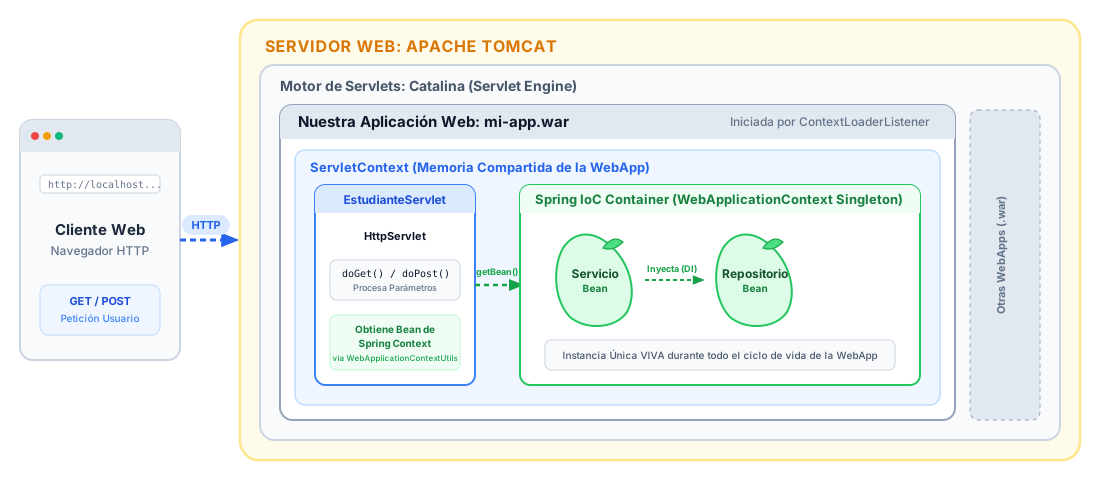
Layer Breakdown in the Web Server
- Web Client (Browser): Sends HTTP requests (
GET / POST) over the network to web server port (e.g.8080). - Apache Tomcat Web Server: Receiving application hosting the servlet execution engine.
- Catalina Engine (Servlet Engine): The central Tomcat component responsible for managing deployed web applications (
.war) and routing HTTP requests to the appropriate Servlet. ServletContext(Shared WebApp Memory): Memory map persisting throughout the entire web application lifecycle. Coexisting within it are:- The Servlets (
EstudianteServlet) serving requests. - The Spring IoC Container (
WebApplicationContext), initialized once upon Tomcat startup viaContextLoaderListener.
- The Servlets (
- Living Spring Beans: Service and Repository beans reside in Spring container as Singleton objects, consumed by Servlets without re-reading XML.
3. web.xml Configuration (Web Deployment)
To enable automatic Spring context loading in a traditional web application, configure web.xml:
<?xml version="1.0" encoding="UTF-8"?>
<web-app xmlns="https://jakarta.ee/xml/ns/jakartaee"
         xmlns:xsi="http://www.w3.org/2001/XMLSchema-instance"
         xsi:schemaLocation="https://jakarta.ee/xml/ns/jakartaee
                             https://jakarta.ee/xml/ns/jakartaee/web-app_6_0.xsd"
         version="6.0">

    <!-- 1. Location of Spring XML configuration file -->
    <context-param>
        <param-name>contextConfigLocation</param-name>
        <param-value>classpath:applicationContext.xml</param-value>
    </context-param>

    <!-- 2. Spring Listener initializing ApplicationContext on Tomcat startup -->
    <listener>
        <listener-class>org.springframework.web.context.ContextLoaderListener</listener-class>
    </listener>

</web-app>
As of Spring 6 and Tomcat 10+, applications use the jakarta.servlet namespace. Ensure your spring-web dependencies are version 6.0 or higher.
4. Implementation of Spring-Integrated Servlet
With context loaded on startup by the listener, the Servlet retrieves the single service reference during its init() initialization method or in doGet():
package com.example.servlet;

import com.example.model.Estudiante;
import com.example.service.EstudianteService;
import jakarta.servlet.ServletException;
import jakarta.servlet.annotation.WebServlet;
import jakarta.servlet.http.HttpServlet;
import jakarta.servlet.http.HttpServletRequest;
import jakarta.servlet.http.HttpServletResponse;

import org.springframework.web.context.WebApplicationContext;
import org.springframework.web.context.support.WebApplicationContextUtils;

import java.io.IOException;
import java.io.PrintWriter;
import java.util.List;
import java.util.UUID;

@WebServlet(name = "estudianteServlet", value = "/estudiantes")
public class EstudianteServlet extends HttpServlet {

    private EstudianteService estudianteService;

    @Override
    public void init() throws ServletException {
        super.init();

        // Retrieve Singleton ApplicationContext stored in ServletContext by Listener
        WebApplicationContext context = WebApplicationContextUtils
                .getRequiredWebApplicationContext(getServletContext());

        // Extract service bean injected via XML
        this.estudianteService = (EstudianteService) context.getBean("estudianteServiceBean");
    }

    // 1. GET Method: Renders HTML form and student list
    @Override
    protected void doGet(HttpServletRequest request, HttpServletResponse response)
            throws ServletException, IOException {

        response.setContentType("text/html;charset=UTF-8");
        PrintWriter out = response.getWriter();

        List<Estudiante> estudiantes = this.estudianteService.listarEstudiantes();

        out.println("<!DOCTYPE html>");
        out.println("<html><head><title>Student Management - Spring + Servlets</title></head><body>");
        out.println("<h1>Student Management (Spring Context + Servlets)</h1>");

        // HTML form to register a new student via POST
        out.println("<h2>Register New Student</h2>");
        out.println("<form action='estudiantes' method='POST'>");
        out.println("  <label>Name:</label><br/>");
        out.println("  <input type='text' name='nombre' required/><br/><br/>");
        out.println("  <label>Email:</label><br/>");
        out.println("  <input type='email' name='correo' required/><br/><br/>");
        out.println("  <button type='submit'>Save Student</button>");
        out.println("</form>");

        out.println("<hr/>");
        out.println("<h2>Registered Students List</h2>");
        out.println("<ul>");
        for (Estudiante e : estudiantes) {
            out.println("<li><strong>" + e.getNombre() + "</strong> - " + e.getCorreo() + "</li>");
        }
        out.println("</ul>");
        out.println("</body></html>");
    }

    // 2. POST Method: Receives form data, invokes Service Layer, and redirects
    @Override
    protected void doPost(HttpServletRequest request, HttpServletResponse response)
            throws ServletException, IOException {

        // Extract parameters submitted by HTML form
        String nombre = request.getParameter("nombre");
        String correo = request.getParameter("correo");

        // Create Domain Model object
        String idGenerado = UUID.randomUUID().toString().substring(0, 8);
        Estudiante nuevoEstudiante = new Estudiante(idGenerado, nombre, correo);

        // Delegate execution to Service Layer (Spring Bean)
        this.estudianteService.registrarEstudiante(nuevoEstudiante);

        // Redirect (Post-Redirect-Get Pattern) to refresh list
        response.sendRedirect(request.getContextPath() + "/estudiantes");
    }
}
5. Complete Maven Project Structure (war)
To compile and package a web application integrating Servlets with Spring, standard Maven folder structure should be organized as follows:
src/
├── main/
│   ├── java/
│   │   └── com/example/
│   │       ├── model/
│   │       │   └── Estudiante.java
│   │       ├── repository/
│   │       │   ├── EstudianteRepository.java
│   │       │   └── EstudianteRepositoryInMemory.java
│   │       ├── service/
│   │       │   ├── EstudianteService.java
│   │       │   └── EstudianteServiceImpl.java
│   │       └── servlet/
│   │           └── EstudianteServlet.java
│   ├── resources/
│   │   └── applicationContext.xml
│   └── webapp/
│       └── WEB-INF/
│           └── web.xml
└── pom.xml
Required Dependencies in pom.xml:
<dependencies>
    <!-- 1. Spring Context and Spring Web -->
    <dependency>
        <groupId>org.springframework</groupId>
        <artifactId>spring-web</artifactId>
        <version>6.0.11</version>
    </dependency>

    <!-- 2. Jakarta Servlet API -->
    <dependency>
        <groupId>jakarta.servlet</groupId>
        <artifactId>jakarta.servlet-api</artifactId>
        <version>6.0.0</version>
        <scope>provided</scope>
    </dependency>
</dependencies>