Guards, Passport, and JSON Web Tokens (JWT)
Implementing an enterprise-grade security layer in NestJS requires understanding how three essential architectural pieces interact: the native Guards system, the battle-tested Passport authentication library via the Strategy pattern, and the JSON Web Tokens (JWT) standard.
In this guide, we analyze the architectural responsibility of Guards across the NestJS request lifecycle, the loose coupling enabled by the Strategy pattern, and the cryptographic anatomy of JWT tokens.
1. What is a Guard in NestJS?
A Guard is an @Injectable() class implementing the CanActivate interface. Its sole responsibility is to evaluate whether an incoming HTTP request is authorized to proceed to the targeted route handler.
Position in the Request Lifecycle
Unlike traditional Express middlewares (which have no awareness of which controller class or handler method will execute next), Guards run after middlewares but before interceptors and validation pipes.
Guards receive the ExecutionContext instance, allowing them to inspect:
- The transport protocol context (HTTP, WebSockets, Microservices, or GraphQL).
- The underlying request object (
Requestfrom Express or Fastify). - Metadata attached to the controller class or route handler method (via
Reflector).
The CanActivate Interface
Every Guard must implement the canActivate contract:
export interface CanActivate {
  canActivate(
    context: ExecutionContext,
  ): boolean | Promise<boolean> | Observable<boolean>;
}
- Returning
trueallows the request pipeline to continue toward pipes and interceptors. - Returning
falsecauses NestJS to halt execution immediately and issue an HTTP403 Forbiddenresponse. - Throwing a recognized HTTP exception (e.g.,
UnauthorizedException) causes NestJS to emit the corresponding HTTP status code (401 Unauthorized).
2. The Passport Ecosystem and the Strategy Pattern
Passport is the predominant, field-tested authentication framework for Node.js. Its flexibility stems from its modular architecture centered on the Strategy design pattern.
What is the Strategy Pattern?
The Strategy Pattern is a behavioral software design pattern that defines a family of algorithms, encapsulates each one into a dedicated class, and makes their instances interchangeable at runtime without altering client code.
How Does NestJS Apply the Strategy Pattern?
Rather than coupling authentication logic directly inside controllers or middlewares:
- The
@nestjs/passportintegration package provides thePassportStrategybase class. - We create dedicated strategy classes (such as
JwtStrategy) that configure how the token is extracted (e.g., from theAuthorization: Bearer <token>header) and how its payload is verified. - In controller routes, we simply bind the generic
AuthGuard('jwt'). If authentication requirements evolve or OAuth2 providers are introduced in the future, controllers remain untouched.
3. Structure and Mechanics of JSON Web Tokens (JWT) (RFC 7519)
A JSON Web Token (JWT) is an open, standardized specification (RFC 7519) defining a compact, self-contained mechanism for securely transmitting structured information between parties as a JSON object.
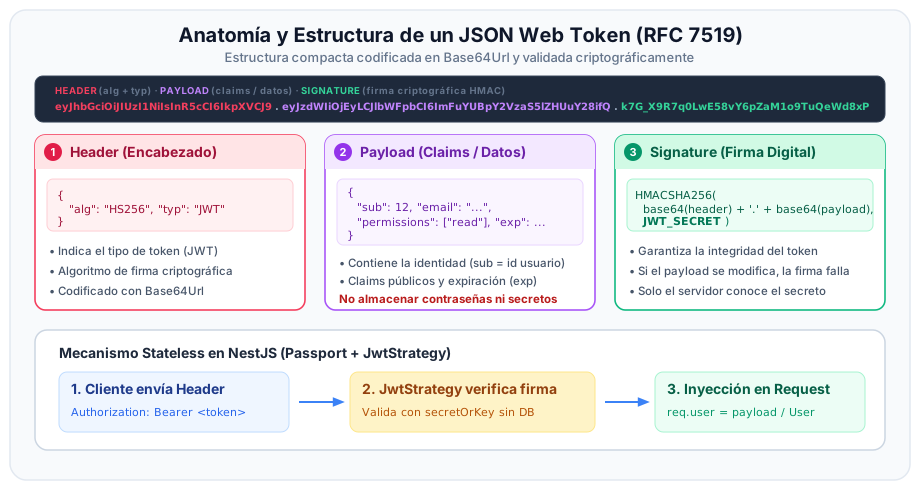
Anatomy of a JWT Token
A JWT token consists of three distinct strings separated by periods (.):
eyJhbGciOiJIUzI1NiIsInR5cCI6IkpXVCJ9.eyJzdWIiOjEyLCJlbWFpbCI6ImFuYUBpY2VzaS5lZHUuY28ifQ.k7G_X9R7q0LwE58vY6pZaM1o9TuQeWd8xP
1. Header
Indicates token metadata: token type (typ: "JWT") and the cryptographic algorithm employed to produce the digital signature (e.g., alg: "HS256" for HMAC-SHA256 or RS256 for RSA public/private key pairs).
{
  "alg": "HS256",
  "typ": "JWT"
}
2. Payload (Claims)
Contains assertions (claims) regarding an entity (typically the authenticated subject) alongside contextual metadata:
- Registered Claims (RFC 7519):
sub(Subject): The unique identifier of the user (e.g., database primary key).iat(Issued At): Epoch timestamp when the token was generated.exp(Expiration Time): Epoch timestamp marking when the token ceases to be valid.
- Public / Custom Claims:
- Non-sensitive domain data required by client applications, such as
email,role, or grantedpermissions.
- Non-sensitive domain data required by client applications, such as
{
  "sub": 12,
  "email": "ana@icesi.edu.co",
  "permissions": ["users:read", "users:create"],
  "iat": 1773517905,
  "exp": 1773521505
}
The Header and Payload segments are merely Base64Url-encoded, not encrypted. Any network intermediary or client inspecting the token can decode and view its claims instantly. Never place passwords, secret keys, or credit card numbers inside a JWT payload.
3. Signature
The signature guarantees the integrity and authenticity of the token. It is calculated by hashing the encoded header, encoded payload, and an application secret key known only to the backend server (JWT_SECRET):
HMACSHA256(
  base64UrlEncode(header) + "." + base64UrlEncode(payload),
  JWT_SECRET
)
If an attacker tampers with the sub claim or modifies permissions in the payload, the server's computed signature will mismatch the incoming token signature, rejecting the request instantly.
4. Stateful vs. Stateless: Why JWT?
Adopting JWT over traditional cookie-based sessions represents a major architectural divergence:
| Architectural Metric | Stateful Sessions (Cookie-Based) | Stateless Tokens (JWT) |
|---|---|---|
| State Storage | Server memory or distributed store (Redis, SQL). | Client-side (in-memory storage or HttpOnly cookies). |
| Horizontal Scaling | Requires shared session stores (sticky sessions or Redis clusters). | Seamless; any backend replica configured with JWT_SECRET validates requests. |
| Server Memory Overhead | Grows proportionally with the volume of concurrent sessions. | Negligible; the server holds zero active session records in memory. |
| Network Overhead | Low (cookie only transports a compact Session ID). | Moderate (tokens carry claims, expanding HTTP request headers). |
| Immediate Revocation | Instantaneous (simply remove the session key from Redis). | Challenging (valid until expiry unless blacklisting/revocation caches are built). |
5. Dependency Installation
To implement this security architecture in NestJS, install the following production and development packages:
npm install @nestjs/passport passport passport-jwt @nestjs/jwt
npm install -D @types/passport-jwt
Overview of Each Package:
@nestjs/passport: The official module integrating Passport into NestJS's Dependency Injection system, providingPassportStrategyandAuthGuard.passport: Core Node.js authentication middleware library.passport-jwt: Passport strategy for extracting and verifying JWT tokens from HTTP request headers (Bearer <token>).@nestjs/jwt: Utility module wrappingjsonwebtokenfor signing and verifying tokens via an injectable service.@types/passport-jwt: TypeScript type definitions ensuring static type safety across JWT strategies.