Requirements in Software Development
Requirements describe the needs and constraints that a software product must satisfy to contribute to solving a real-world problem. They act as a medium of communication between stakeholders and the development team, establishing the foundation for technical and management activities throughout the project lifecycle.
From a software development perspective, requirements can be understood through two complementary viewpoints:
- Expression of needs: Describes what the system is expected to do and under what conditions, based on real-world context needs.
- Framework for development: Guides analysis, design, implementation, and verification decisions for the system.
If the team performs poorly during requirement determination, common issues arise:
- Increased development time
- Project cost overruns
- Significant delays or cancellations
Requirement-Related Problems
In practice, there are two primary problems associated with requirements:
- Incompleteness: Occurs when not all relevant needs, business rules, or system constraints are captured.
- Ambiguity: Occurs when a requirement can be interpreted in more than one way, potentially leading to inconsistent implementations.
These problems usually stem from a limited understanding of the domain, poor communication with stakeholders, or imprecise documentation.
Requirements and the Software Lifecycle
Requirements are present throughout all phases of the software development lifecycle and are not limited to an initial phase.
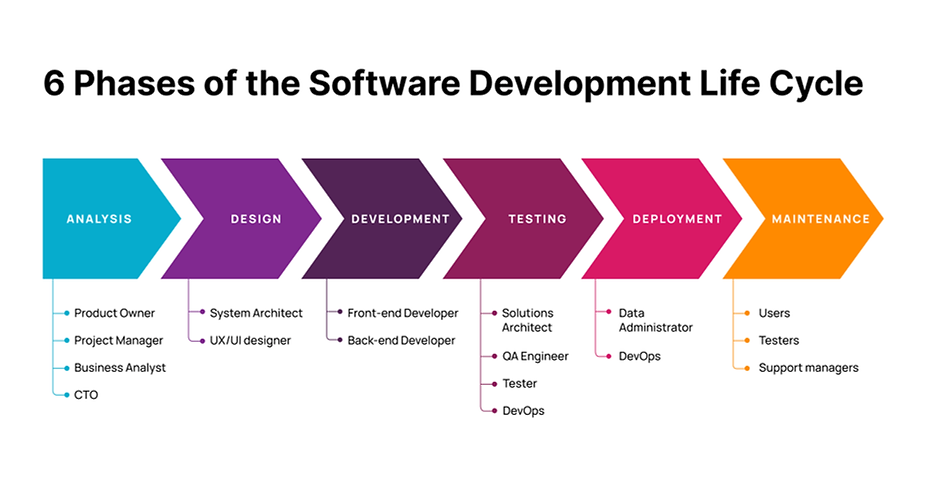
Requirement analysis is often one of the most underestimated phases in software development, despite its results directly influencing all subsequent phases.
In this context, software requirements:
- Are not necessarily a front-end or project-start activity.
- Constitute a continuous process adjusted as system understanding evolves.
- Must link to the organization and project context, including technical, organizational, and operational aspects.
Fundamentals of Requirements
Requirements are defined as:
- A condition or capability needed by a user to solve a problem or achieve an objective.
- A condition or capability that must be met or possessed by a system to satisfy a contract, standard, specification, or other formally imposed document.
- A statement identifying a need, capability, feature, or quality attribute that must be included in the system.
These definitions reflect that requirements may originate both from explicit user needs and from external constraints imposed on the system.
Types of Requirements
There are two main types of requirements.
1. Software Product Requirements
Specify the expected form and behavior of the software once developed.
1.1 Functional Requirements
Describe the functions or services the system must provide. They indicate how the system should react to specific inputs or events.
Common examples include:
- Information processing
- User interaction
- Communication with other systems
1.2 Non-Functional Requirements
Describe constraints under which the system must operate. They do not define what the system does, but how it does it.
Include aspects such as:
- Performance: response times, processing capacity
- Usability: ease of use, accessibility
- Reliability: availability, fault tolerance
- Security: confidentiality, integrity, authentication
1.2.1 Technology Constraints
Mandate or forbid specific technologies, platforms, or infrastructures.
Examples:
- Permitted programming languages: Java, Python, JavaScript
- Deployment infrastructure: cloud, on-premise, hybrid
- Database engines: MySQL, PostgreSQL, etc.
1.2.2 Quality Constraints
Establish expectations related to system behavior.
Typical questions associated with this type of requirement include:
- On what computing platforms must the system execute?
- Which database engine must be used?
- How quickly should results be presented to the user?
2. Software Process Requirements
Specify the activities and resources needed to develop the software.
Include aspects such as:
- Costs
- Timeline / Schedule
- Personnel
- Tools and development environment
These requirements directly influence project planning and management.
Requirement Elicitation
Requirement elicitation is the process of discovering, documenting, and understanding software requirements from the perspective of stakeholders.
Stakeholders
A stakeholder is any individual or entity that:
- Is actively involved in the project
- Is affected by the project outcome
- Can influence the project outcome
Typical stakeholders include:
- Clients
- End users
- Developers
- Project managers
Elicitation Techniques
Requirements can be gathered through various techniques, including:
- Interviews
- Meetings
- Questionnaires
- Protocol analysis
- Focus groups
Other Requirement Sources
In addition to stakeholders, requirements can be elicited from:
- Past versions of the system
- Interfacing external systems
- Literature reviews
- Scenario descriptions
Requirement Analysis
Requirement analysis is the process of examining elicited requirements to ensure they are complete, consistent, and viable.
During this process, requirements must meet the following criteria:
- Be unambiguous, interpretably only in one way
- Be verifiable, so compliance can be tested
- Be atomic, avoiding combined requirements in a single statement
- Represent a real user or system need
- Use problem domain vocabulary
- Be acceptable to stakeholders
Overall, requirements must be: complete, concise, consistent, and viable.
Requirement Specification
Requirement specification consists of structuring documentation to facilitate usage during development.
Project management tools help organize requirements and development tasks.
Common tools include:
Writing Requirements
The way requirements are drafted is crucial for their comprehension and effective use. Clear, precise, and well-structured writing reduces ambiguity and enables teams to deliver solutions that satisfy system needs.
Characteristics of Good Requirement Writing
A well-written requirement must be:
- Clear: Easy to read and understand by all stakeholders
- Precise: Uses specific terms and avoids vagueness
- Concise: Expresses the complete idea without unnecessary wording
- Verifiable: Can be proven through testing or inspection
- Traceable: Can be tracked from origin to implementation
Common Writing Structure
For functional requirements, the standard format is:
The system must [action] [object] [optional condition]
For non-functional requirements:
The system must [quality characteristic] [measurable metric] [in specific context]
Recommended Writing Patterns
1. Imperative Verbs
- Must (mandatory)
- Should (recommended)
- May (optional)
Examples:
- "The system must validate email format before registering a user."
- "The system should show a confirmation message after saving data."
- "The system may allow exporting reports in PDF format."
2. Avoiding Ambiguity
Avoid subjective words like "adequate", "fast", "easy", or "flexible".
Incorrect: "The system must have a fast response time."
Correct: "The system must respond to user queries in less than 2 seconds under normal operating conditions."
3. Atomic Requirements
Each requirement must express a single need.
Incorrect: "The system must allow users to register, log in, and recover their password."
Correct:
- "The system must allow users to create an account by providing an email and password."
- "The system must allow users to log in using email and password."
- "The system must allow users to reset their password via a link sent to their email."
Requirements Activity
An organization dedicated to social and recreational activities, focused on board games and organized competitive events, needs an information system to manage events and community interactions.
Instructions
- Identify and document 15 functional requirements formatted as user stories:
As [user role], I want to [action] so that [benefit] - Propose 3 non-functional requirements with measurable criteria.
- Submit a PDF containing the 15 User Stories (US-001, US-002...) and 3 NFRs.